Strategic Environmental Assessment of Community Development Strategies: What communities experience show us in Ukraine
In connection with the signing of the Association Agreement with the European Union and in accordance with Directive 2001/42/EC and the Protocol on Strategic Environmental Assessment to the Convention on Environmental Impact Assessment in a Transboundary Context, Ukraine adopted Law No. 2354-VIII of March 20, 2018 “On Strategic Environmental Assessment”. It is this Act that establishes the legal framework for conducting strategic environmental assessments of state planning documents.
A Strategic Environmental Assessment (SEA) is a procedure for identifying, describing, and evaluating the environmental impacts of implementing national planning documents, including their effects on public health. State planning documents include strategies, plans, schemes, urban planning documentation, state target programs, and other policy documents that are developed or approved by state authorities or local governments.
The SEA procedure is also linked to the achievement of the goals set out in Ukraine’s Sustainable Development Goals for the period up to 2030, particularly regarding sustainable cities and communities, responsible consumption and production, combating climate change, and the conservation of ecosystems.
To the NGO "Logistics Center for Community Development" Communities often reach out with questions about the SEA: when it is required, which documents it applies to, what stages it involves, and how environmental issues should be taken into account when developing a development strategy.
To gain a better understanding of SEA practices, our team analyzed data from Unified Register of Strategic Environmental Assessments regarding community development strategies and action plans. The analyzed portion of the registry contains regional government planning documents, including development strategies, action plans, “strategy + action plan” documents, and amendments and updates to strategic documents.
What the analysis of the Unified Register of CEOs reveals
For the analysis, we selected records related to development strategies for local communities and action plans for their implementation. If the title of a document referred to both a strategy and an action plan, that community was counted in both categories: as a community with a record of a strategy and as a community with a record of an action plan.
To calculate the proportion, we used the number of territorial communities in each region, as reported by the “Decentralization” portal. The portal states that 1,469 territorial communities have been established in Ukraine, including 31 communities in the uncontrolled territories within the Donetsk and Luhansk regions; the portal also provides the number of communities by region.
Important: The figures below reflect the proportion of communities for which the analyzed registry data set contains records of SEAs for strategies or action plans. This does not constitute a legal opinion regarding the completeness or quality of each community’s implementation of the CEO procedure.
| Region | Number of local communities in the region | local communities with a SEA for strategic planning | Percentage of local communities | local communities with an SEA for action plans | Percentage of local communities |
| Vinnytsia | 63 | 6 | 9,5% | 5 | 7,9% |
| Volyn | 54 | 10 | 18,5% | 6 | 11,1% |
| Dnipropetrovsk | 86 | 23 | 26,7% | 16 | 18,6% |
| Donetsk | 46 | 6 | 13,0% | 3 | 6,5% |
| Zhytomyr | 66 | 17 | 25,8% | 5 | 7,6% |
| Zakarpattia | 64 | 24 | 37,5% | 19 | 29,7% |
| Zaporizhzhia | 67 | 7 | 10,4% | 1 | 1,5% |
| Ivano-Frankivsk | 62 | 13 | 21,0% | 4 | 6,5% |
| Kyiv | 69 | 25 | 36,2% | 7 | 10,1% |
| Kirovograd | 49 | 17 | 34,7% | 9 | 18,4% |
| Luhansk | 26 | 1 | 3,8% | 0 | 0% |
| Lviv | 73 | 33 | 45,2% | 28 | 38,4% |
| Mykolaiv | 52 | 13 | 25,0% | 10 | 19,2% |
| Odessa | 91 | 15 | 16,5% | 7 | 7,7% |
| Poltava | 60 | 55 | 91,7% | 16 | 26,7% |
| Rivne | 64 | 36 | 56,2% | 13 | 20,3% |
| Sumy | 51 | 14 | 27,5% | 9 | 17,6% |
| Ternopil | 55 | 17 | 30,9% | 8 | 14,5% |
| Kharkiv | 56 | 26 | 46,4% | 24 | 42,9% |
| Kherson | 49 | 5 | 10,2% | 3 | 6,1% |
| Khmelnytskyi | 60 | 21 | 35,0% | 7 | 11,7% |
| Cherkasy | 66 | 20 | 30,3% | 6 | 9,1% |
| Chernivtsi | 52 | 5 | 9,6% | 2 | 3,8% |
| Chernihiv | 57 | 22 | 38,6% | 14 | 24,6% |
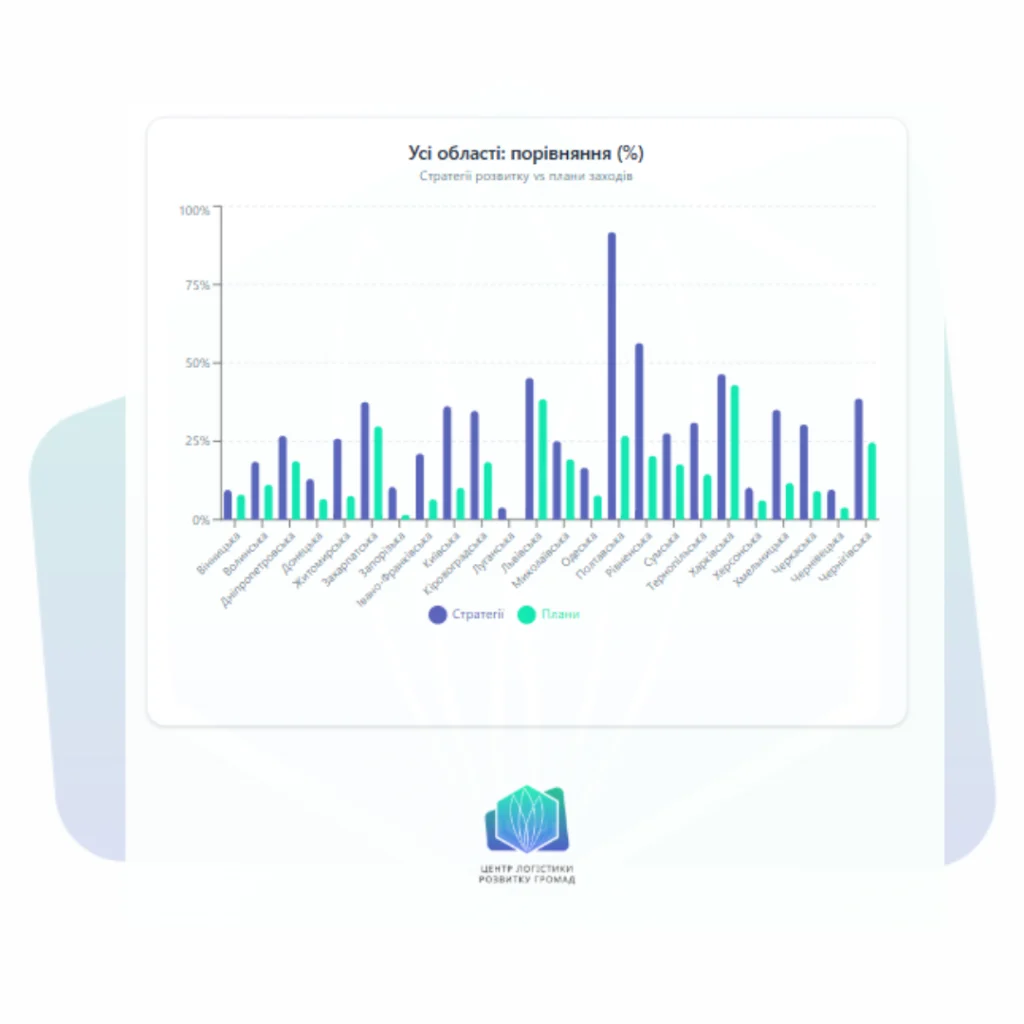
According to the analyzed data, the highest proportion of communities with documents regarding a SEA for development strategies recorded in the registry is observed in Poltava region — 91.7%, Rivne — 56.2%, Kharkiv — 46.4%, Lviv — 45.2%, Chernihiv — 38.6%, Zakarpattia — 37.5% and Kyiv — 36.2%.The highest figures for the action plans are Kharkiv Region — 42.9%, Lviv — 38.4%, Zakarpattia — 29,7%, Poltava — 26.7%, Chernihiv — 24.6% and Rivne — 20.3%.
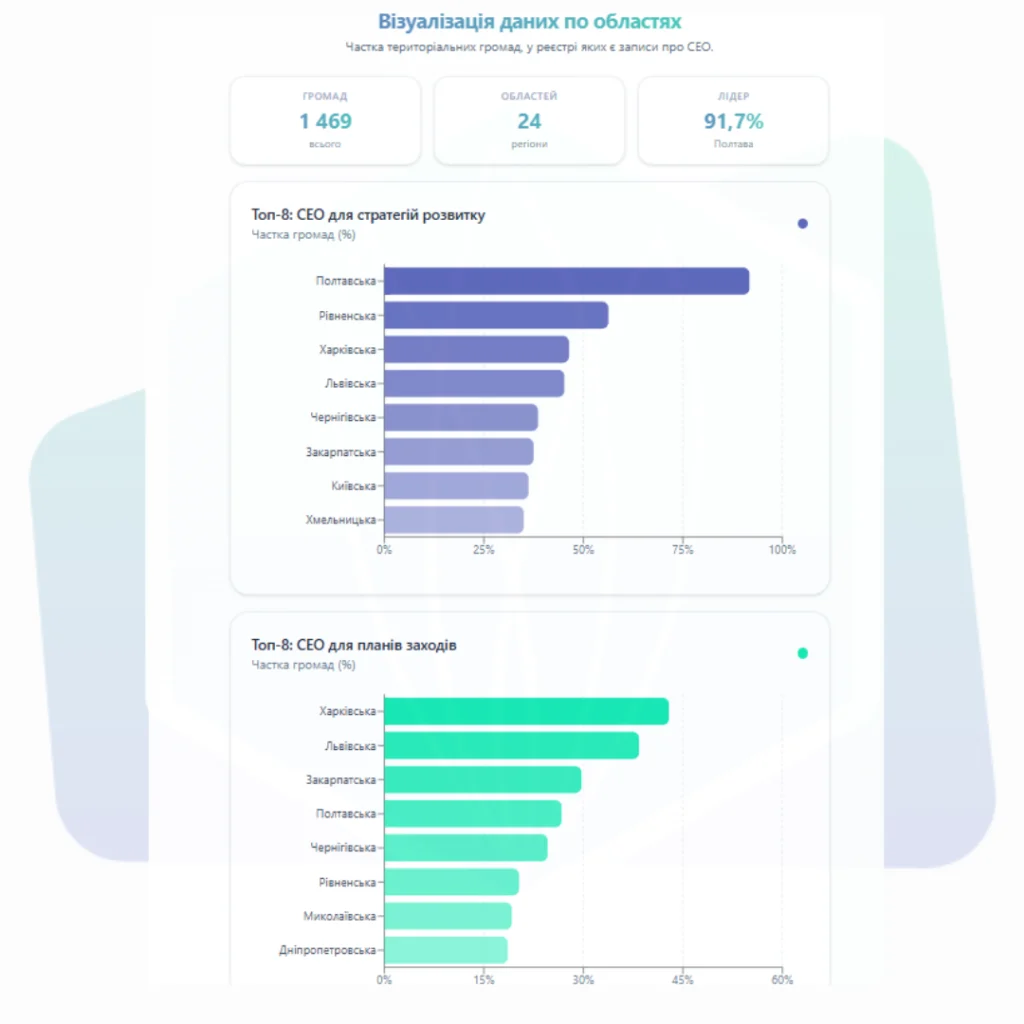
These data show that the SEA applies not only to community development strategies but also to action plans for their implementation. For local governments, this is an important practical message: the environmental component should be taken into account as early as the stage of defining goals, objectives, and the project portfolio, rather than only at the final stage of document preparation.
Legal Framework for the SEA
The primary legislative act is the Law of Ukraine “On Strategic Environmental Assessment”. It defines the concept of a SEA, state planning documents, the parties involved in the procedure, the scope of the Act, the stages of the assessment, and the requirements for the report, public discussion, consultations, and monitoring.
The regulatory framework consists of:
- The Law of Ukraine “On Strategic Environmental Assessment”;
- Guidelines for conducting strategic environmental assessments of state planning documents;
- Criteria for determining environmental impacts, including impacts on public health;
- Procedures for monitoring the environmental impacts of the implementation of a state planning document;
- Procedures for Maintaining the Unified Register of Strategic Environmental Assessments.
The law applies to state planning documents relating, in particular, to agriculture, forestry, fisheries, energy, industry, transportation, waste management, water resource use, environmental protection, telecommunications, tourism, urban planning, or land use planning. At the same time, such documents must provide for the implementation of activities or projects for which environmental impact assessment is required by law, or require an assessment due to potential impacts on areas with protected status.
The Purpose of a Strategic Environmental Assessment
The goal of the SEA is to promote sustainable development by ensuring environmental protection, public safety, and public health, and by integrating environmental requirements into the development and approval of state planning documents.
In practice, this means that when developing a strategy or action plan, it is necessary to analyze how the proposed solutions may affect water, air, soil, climate, biodiversity, landscapes, protected areas, public health, cultural heritage sites, and residents’ living conditions.
The law defines environmental impacts broadly: these include any potential impacts on flora, fauna, biodiversity, soil, subsoil, climate, air, water, landscape, natural areas and sites, public safety, public health, material assets, cultural heritage sites, and the interaction of these factors.
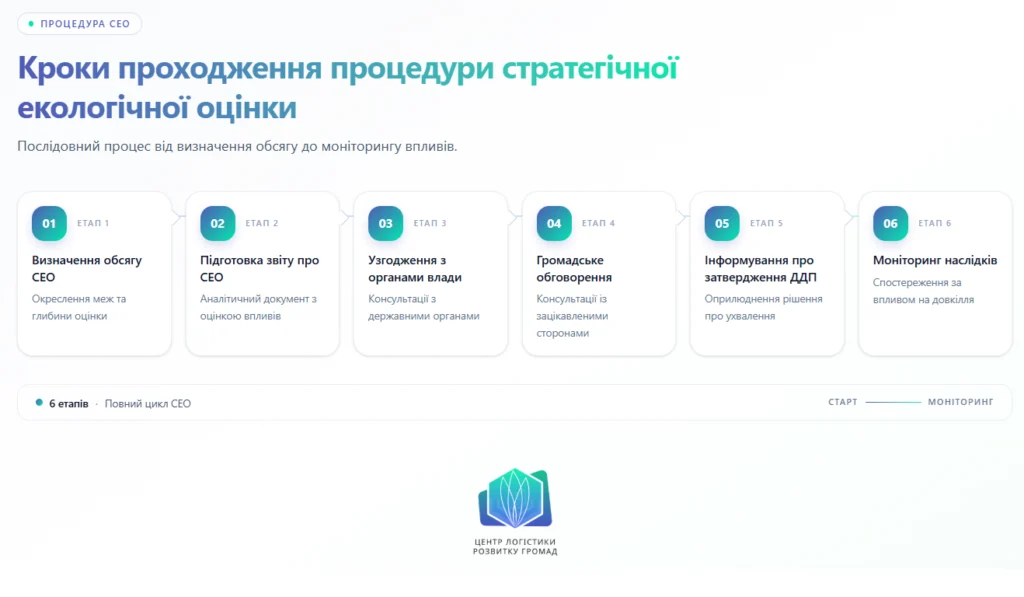
Key Stages of a SEA
The law defines the following stages of the strategic environmental assessment:
- determining the scope of the SEA;
- preparing a SEA report;
- conducting public discussions and consultations;
- taking into account the CEO’s report, the results of public discussions, and consultations;
- notification of the approval of a state planning document;
- monitoring the environmental impacts of the document’s implementation, including its effects on public health.
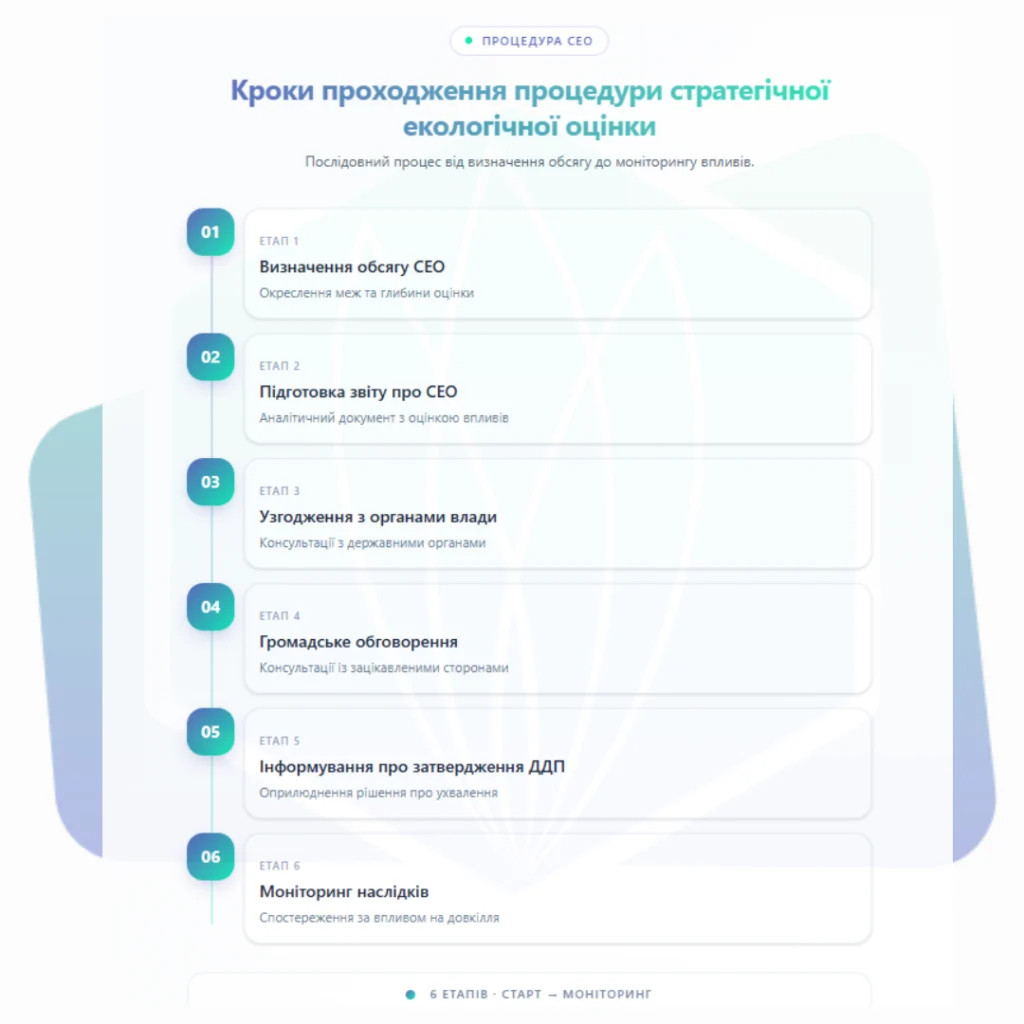
During the assessment process, it is important to gather information on community development, determine the current state of the environment and public health, evaluate the impact of planning decisions, analyze alternatives, and ensure communication with the public and government agencies.
How does this relate to the development of community strategies?
The NGO "Logistics Center for Community Development" does not conduct the SEA procedure as a specialized contractor for strategic environmental assessment.
At the same time, when developing development strategies, our team considers the environment as one of the key aspects of community life. This is important because development strategies often include decisions that may relate to land use, water resources, infrastructure development, transportation, waste management, energy, urban planning, tourism, or spatial development.
During the strategic planning phase, we help communities:
- describe the current state of the environmental sector;
- identify the main issues and needs;
- link environmental issues to other areas of community development;
- formulate goals and objectives in the field of environmental protection;
- include the relevant projects in the community development portfolio.
Such a portfolio may include projects related to waste management, the elimination of illegal landfills, the restoration of water bodies, improvements to drainage systems, the creation of green spaces, the development of environmental education, climate change adaptation, the conservation of natural areas, and the enhancement of energy efficiency in municipal infrastructure.
Such projects do not replace the SEA process. They help the community develop a more robust strategy, better understand the link between environmental issues and management decisions, and create a realistic action plan.
Conclusion
An analysis of data from the Unified Register of Strategic Environmental Assessments shows that a significant number of communities are already undergoing SEA procedures for their development strategies and action plans. The most active implementation has been observed in the Poltava, Rivne, Kharkiv, Lviv, Chernihiv, Zakarpattia, and Kyiv regions.
It is important for communities to understand that the environmental component of the strategy must be substantive, with clearly defined issues, objectives, indicators, and projects. This facilitates further work on the document, makes the strategy more well-founded, and creates a better basis for interaction with experts, the public, and the authorities involved in the SEA process.
The NGO "Logistics Center for Community Development" As part of its work on strategic planning, it helps communities systematically address environmental issues and translate identified problems into concrete project solutions within the community’s development portfolio.
The Resource Center of the NGO "Logistics Center for Community Development" operates with the support of the International Renaissance Foundation as part of the “Impulse” project, which enables us to provide systematic consulting to communities on strategic planning, particularly regarding the integration of environmental considerations and an understanding of the strategic environmental assessment process.
Author: